Case Study 01
Points are easy. An economy is hard.
Designing XP for learners first, then for the managers who were meant to keep them going.
At a glance
- Problem
- Percipio rewarded finishing things, but nothing carried over: people came when a deadline told them to, then left. Managers, who were meant to keep the momentum going, barely showed up.
- What I decided
- An XP economy rather than points: per-minute earn rates by content type, a weekly ceiling, six published levels, one XP currency with separate leaderboards for learners and managers, and admin levers so any organisation can tune it or turn it off.
- Result
- In organisations that turned XP on, monthly active learners rose 6.92% in the first month, measured in Pendo. XP shipped to 701 organisations by opt-in. Of the four bets, one failed — most managers still did not show up. One was settled by customers: on the combined leaderboard Product shipped first, managers out-earned learners, and the boards were split as I had proposed. And the level ladder I designed has a 54-week gap in it.
- My role
- Principal designer for the research, economy, IA, interaction and UI, admin configuration and notifications, with product, engineering, content strategy and one supporting designer.
+6.92%
Monthly active learners in organisations that turned XP on
Pendo, the first month after launch
701
Organisations on XP
live by opt-in · 5,360 top earners in the leaderboard export
3.3%
Of organisations where a manager tops the shared leaderboard
learners hold rank 1 in 87% · from the top-earners export
01 — The Problem
The Problem
Percipio rewarded finishing things, but nothing accumulated.
Percipio was good at one thing and bad at what came after it. You would finish a course, get your badge, and that was that. Nothing carried over. Come back next week and the platform had no memory of the effort you had put in.
So people came when they were told to. A deadline landed, or a course got assigned, and they showed up. Then they left. The rhythm of the whole product was set by things happening outside it.
Skillsoft's goal was engagement: more learners coming back, and upskilling beyond what they were assigned.
Managers were meant to fix that. The pitch was that they would push their teams and keep the momentum going. But when I looked at the numbers, they were barely there at all — a small fraction ever logged in, and a smaller fraction ever created an assignment. They were not ignoring us. We had never given them anything useful to do.
So there were two problems sitting under one name. Learners were slowly drifting away. Managers had never arrived in the first place. Anything built to hold a learner's attention would mean nothing to a manager who had never seen the platform. Anything built to drag managers in would feel like being watched to everyone else. One feature had to work for both.
02 — Snapshot
Snapshot
I owned
- Research and discovery
- XP economy design — earn rates, caps, cooldowns, anti-gaming rules
- Information architecture across learner, manager and admin surfaces
- Interaction design and UI
- Admin configuration model
- Notification strategy
Team contributed
- Product management
- Engineering
- Content strategy
- One supporting UX designer
03 — What We Thought Would Happen
What We Thought Would Happen
We were not guessing about whether points move behaviour. Codecademy — Skillsoft's consumer product — had shipped skill XP, run it as a proper experiment, and rolled it out to everyone. The results were statistically significant: code submits up 2.6%, trial starts up 8.5%, and 86% of surveyed users said skill XP made their learning better. That was another team's work, not mine. I inherited it as evidence and had to work out what it meant for us.
2.6%
Codecademy code submit lift — the metric comparable to ours. Not the 8.5% trial conversion, which had no equivalent on a corporate licence.
86%
Surveyed Codecademy users who said XP made their learning better. The figure I leaned on hardest — does not depend on who paid the licence.
Three things the Codecademy result taught us
- The best number did not apply to us — 8.5% was on trial starts, a conversion event with no equivalent on a corporate licence. The metric that had an analogue moved 2.6%. I told the team to expect low single digits. A team expecting 8% that gets 2% kills the next phase; a team expecting 2% ships it.
- The risk turned out to be engineering, not psychology. Codecademy's experiment initially hurt submit rate and the fix was load improvements — XP had added weight to a hot path. That went straight onto our watch list. Not a lesson you get from reading about motivation theory.
- Codecademy learners chose to be there. Ours were assigned. Points amplify motivation that already exists — but when the motivation is a compliance deadline, not curiosity, they can replace it instead. That is the classic way extrinsic rewards backfire.
The question the whole design came from
The question was never 'does XP work?' It was 'does XP work when you did not choose to be here, and the metric it moved elsewhere does not exist here?' That sentence is why XP is ignorable by default, why outcomes are worth more than effort, and why nothing is ever locked behind points.
+2.6%
Code submissions per user
117.5 → 120.5
+8.5%
Trial starts
a conversion event — no equivalent on a corporate licence
86%
Said skill XP enhanced their learning
qualitative survey
Takeaway
We have a hypothesis that XP will work. But, this is a B2C app.
04 — The Four Bets
The Four Bets
Two of these came straight out of the Codecademy result. Two came from the places it could not reach. I wrote all four down before designing anything, with the weakest one named as the weakest, so that being wrong later would be a finding rather than an embarrassment.
A location problem, not a taste problem
1.74% of our users ever opened the badges page. Codecademy's XP accrues inside the editor and moved submits 2.6%. The difference between those two numbers is where the points live, not whether people want them.
Managers respond to recognition
The weakest-supported of the four. Codecademy has no manager role, so I was extending a consumer result onto a surface it had never been tested on. I flagged it at the time as the one most likely to fail. It did.
Outcome-weighting kills farming
Codecademy pays for code submits — intrinsically valuable and tedious to fake. Our equivalent included sending a reminder email. The mechanic only transfers if the payout transfers with it.
One economy beats two
Codecademy has one user population and never had to answer this. It is the question our context created and their evidence could not settle — so I designed the risk to be observable rather than assumed.
How might we…
- make XP valuable without it feeling like a distraction or a gimmick to busy managers?
- reward everyday actions — viewing progress, sending reminders — with XP that means something?
- encourage managers to log in daily without adding to their mental load?
- link XP to real-world impact, like stronger team skills or recognition from leadership?
- personalise XP challenges so they line up with real priorities and team goals?
- use XP to make learning feel continuous rather than task-driven?
- nudge managers with small wins — micro-XP — for the behaviours that build consistency?
- award XP for the quality of assignments, not just their volume?
- let managers co-own team development, and feel rewarded for doing it thoughtfully?
- create social XP dynamics that let managers compare progress with other managers in a healthy way?The one nobody could answer — it became the leaderboard.
05 — Research
Research
Most of the published numbers on gamification come from companies that sell gamification. I read them to understand the pitch buyers were hearing, and kept them out of every decision. The evidence I relied on was our own analytics and Codecademy's experiment.
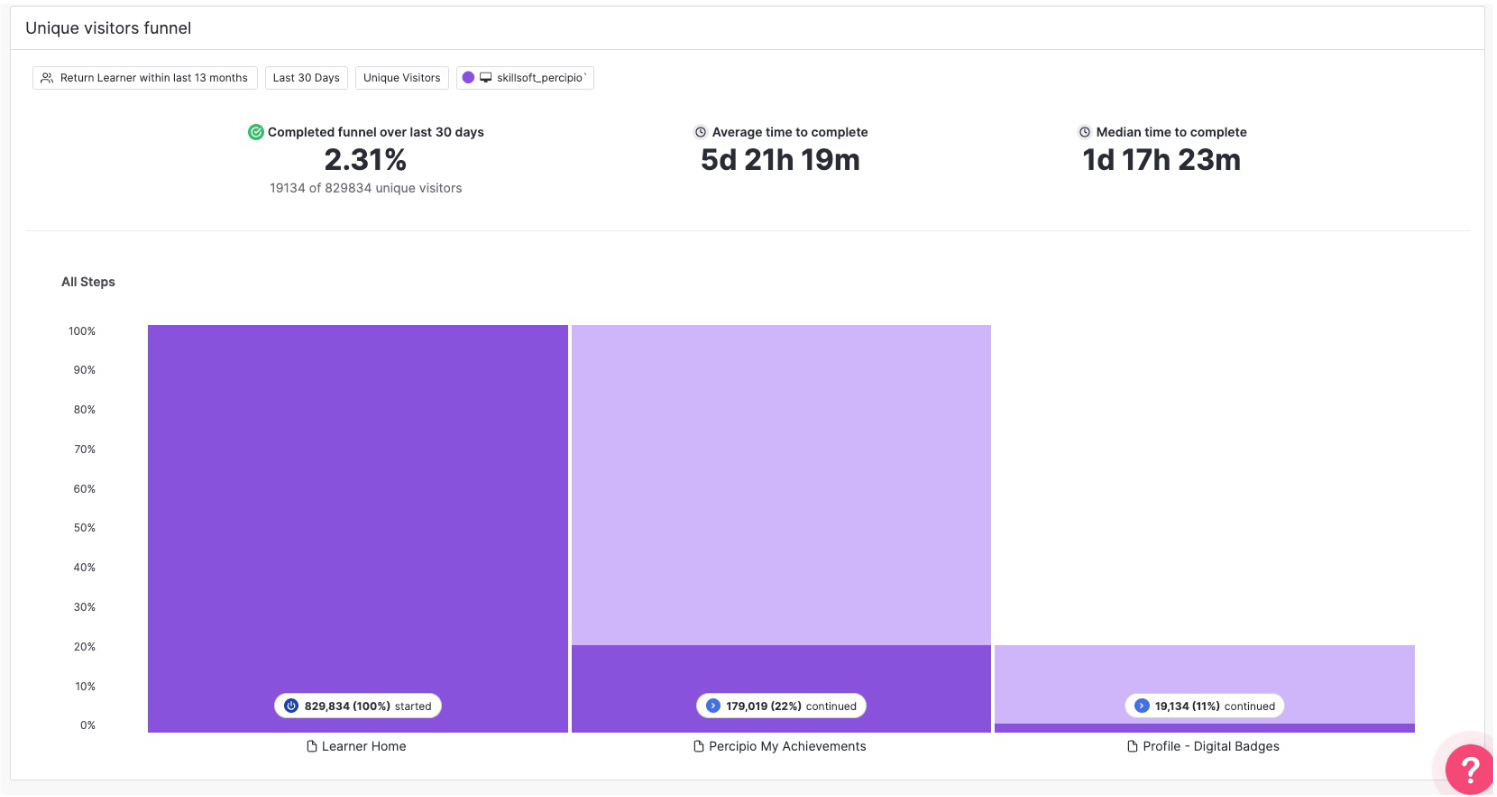
Only 1.74% of learners who came to Percipio used badges. The easy reading is that people don't want gamification. I read it differently: badges lived on a page you had to go looking for, and almost nobody goes looking. Of 829,834 learners on the home page in 30 days, 22% reached My Achievements and 11% of those reached their badges. That backed the first bet — a location problem, not a taste problem — and set the hardest constraint on the project: XP could not be a place you go. It had to be where people already were.
1.74%
Learners who used badges — because badges lived on a page nobody went looking for
What the competition gets wrong
- Salesforce Trailhead: XP for every module and quiz, and a clear climb through ranks. But it never says what XP is for, there's no social layer, and progress stops at the top rank.
- Microsoft Learn: XP straight after each unit, and clear progress bars. But the XP doesn't lead anywhere, nothing rewards coming back regularly, and there's no goal to aim for.
- Both treat XP as a score, not an economy. So neither answers the question that decides whether XP works: what stops people gaming it for points?
The insight that changed the design
One in four. Only the Career Climber actively wants a leaderboard. Building the whole system around ranking would have served a quarter of the audience and annoyed the rest. It is why the leaderboard is a tab, not the front door.
 Open full size
What it shows
- Learners do engage with the gamified parts of the platform.
- They engage more with certificates than with badges.
- Only 1.74% of everyone who comes to Percipio uses badges.
What it doesn't show
- Whether those learners go on to courses and engage with them.
- Minimalist Learner
“I'm here because I have to be — I've got better things to do.”
Does assigned training and nothing else, mostly to stay out of trouble.
What XP has to do
Stay out of the way. XP is ignorable by default, nothing is locked behind points, and outcomes earn more than effort.
No use for a leaderboard
- Career Climber
“I want to master the skills of today and tomorrow so I can excel in my career.”
Wants certifications, visible progress and recognition from leadership.
What XP has to do
Make progress visible: six levels with published thresholds, and a leaderboard that is there as a tab, not the front door.
Wants a leaderboard
06 — What Managers Actually Do
What Managers Actually Do
Before attaching points to anything, I catalogued what managers actually do in Percipio. Fifteen activities — assigning content, running completion reports, nudging overdue learners, joining the learning themselves. Most of them are administrative. Only a few of them change whether anyone learns anything. That list is what turned the bet on outcome-weighting from a theory into a risk: pay for all fifteen equally and you are paying people to send reminder emails.
So I designed how managers earn XP — the same XP learners earn, with five manager tiers from A Starter to Performance Partner, nine earning actions, and a payout weighted by impact rather than frequency. Assigning content paid 40. Nudging an overdue learner paid 25, with the reasoning written into the table next to it: nudging without follow-up gets lower XP. Hitting 80% team completion paid 100 — the most of any action, because it measured an outcome rather than an action.
One currency for everyone was never in question. Where managers rank was. Managers have more ways to earn — assigning, nudging, reporting, on top of their own learning — so on a single board they would outrank the people they manage. I proposed two leaderboards. Product shipped one combined board. Customers soon reported exactly that problem, and the boards were separated.
- Assign content to team members
- Recommend relevant courses for growth or skill gaps
- Track progress on assignments and learning goals
- Run reports for completion, usage and certifications
- View dashboards for assignment status, activity levels and engagement
- Receive alerts and nudges about overdue or upcoming items
- Send reminders to learners for overdue tasks
- Celebrate team achievements — badges, certifications
- Compare team progress against other teams or past performance
- Share or curate content for the team
- Join learning themselves and set personal learning goals
- View hierarchy and team structure and subgroup learning behaviours
- Explore learning recommendations for individuals or groups
- Understand skills gained and identify skill gaps
- Take part in Learn Together sessions
Goal: encourage daily, light-touch engagement by managers that directly improves team learning — without overwhelming them or rewarding vanity actions.
A Starter
Laying the foundation for the team's learning.
10–499 XPActive Coach
Actively guiding and tracking the team's progress.
2500–1,499 XPGrowth Leader
The team's growth reflects consistent effort.
31,500–2,999 XPLearning Champion
Has built a culture of learning and development.
43,000–4,999 XPPerformance Partner
A trusted leader aligning learning with business goals.
55,000+ XP
| Action | Frequency | XP | Type | Notes |
|---|---|---|---|---|
| Assign content to the team | 1× a day | 40 | Core | Tracked through completion rate, so assignments can't be spammed. |
| Recommend skill-based content | 1× a day | 30 | Core | +10 XP when it matches a skill benchmark. |
| View the team dashboard | 1× a day | 20 | Habit | Log in and look at the team snapshot. |
| Nudge overdue learners | 1× a day | 25 | Intervention | A nudge with no follow-up earns less. |
| Celebrate an achievement | 1× a day | 20 | Culture | A badge or certificate — in-app message, comment or email. |
| Run a progress report | 1× a week | 30 | Insight | Once a week, to avoid overuse. |
| Team hits 80% assignment completion | Rolling | 100 | Milestone | The highest payout, because it is an outcome, not an action. |
| Set a learning goal for the team | 1× a quarter | 75 | Planning | Meant to be thoughtful, so infrequent. |
| Curate a learning journey | 1× a month | 100 | Curation | AI-assisted or by hand. |
07 — What I Held Myself To
What I Held Myself To
08 — The Economy
The Economy
This is the actual work. Not what earns points — what refuses to.
Content pays per minute, by type. Courses earn 40 XP a minute. Videos, audiobooks, skill benchmarks, CAISY scenarios and study groups earn 20. Books and summaries earn 15. Journeys pay double. Finishing something substantial is worth meaningfully more than finishing something short, and the rates are published in-product rather than inferred.
Profile actions pay properly, once. 100 XP for setting your role, aspirational role, focus skills or interests. That data is what makes personalisation work, so it is worth paying for. Doing it again is worth half, and only once a week. Re-adding something you already had pays nothing — the system checks history, not just the action.
The week has a ceiling. Learning carries on past it. XP stops. Nobody is ever told to stop learning, but nobody can grind the number either.
Earns XP
- Completing content — weighted by type and length
- Setting profile fields (role, aspirational role, focus skills, interests)
- Manager: team assignments completed above 80%
- Manager: assignments followed by learner action (not just reminders sent)
Does not earn XP
- Re-adding a skill or interest already in your history
- Sending reminders without learner follow-through
- Activity past the weekly ceiling
- Content re-completion at the same rate as first completion
The one I would defend hardest: a manager's score depends on their team, not their clicks. Sending a reminder is worth very little. A learner coming back after that reminder is worth several times more. An assignment finishing above 80% is worth more again. If reminders paid well, managers would spam reminders. Making the payout depend on someone else's response means the only way to score highly is to actually be good at the job.
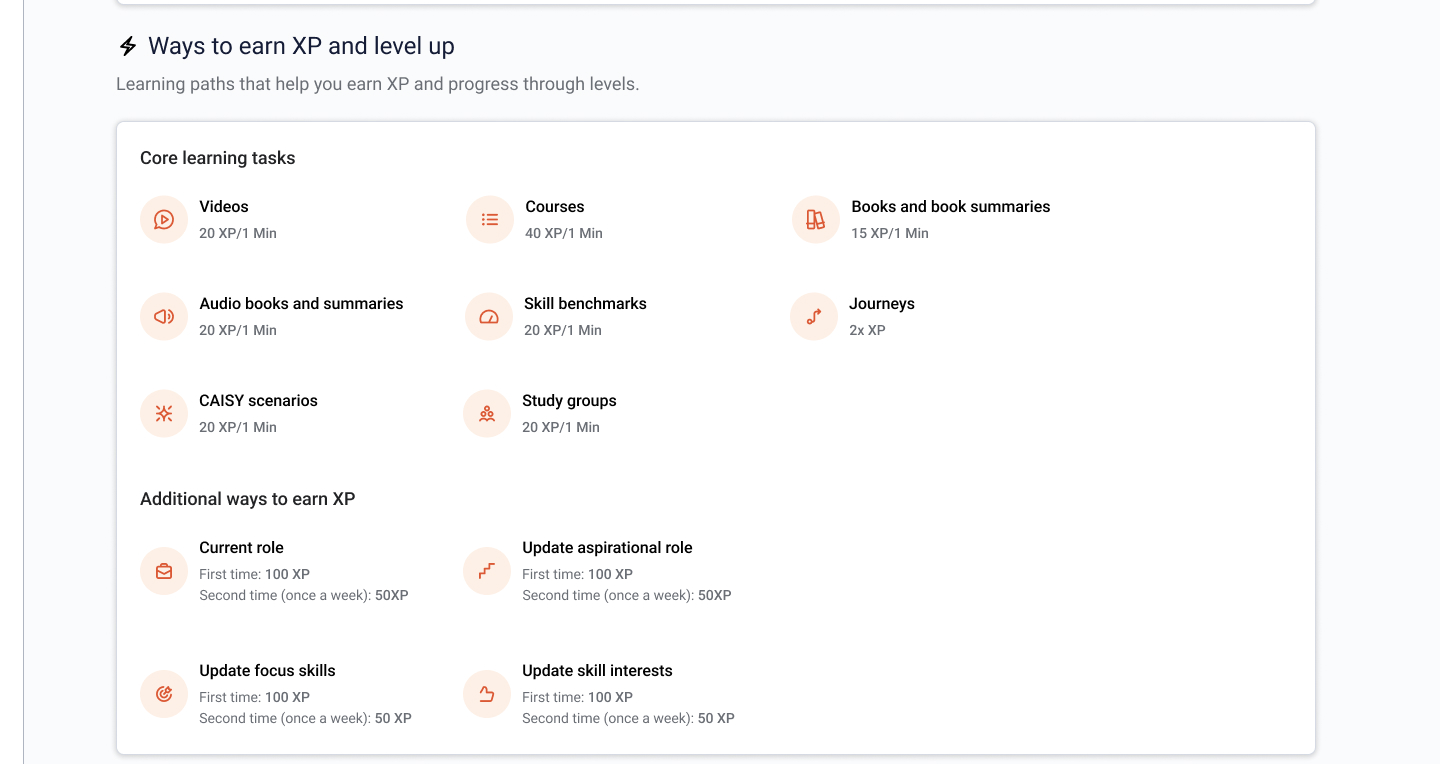
Every rate published in-product — per-minute by content type, journeys at double, profile actions paid once properly and halved on repeat
09 — One Leaderboard or Two
One Leaderboard or Two
Decision
I proposed separate leaderboards for learners and managers. Product shipped one combined board. Customer feedback reversed it: the boards are now separate, as proposed.
Learners earn XP for learning. Managers earn it for learning and for managing — assigning content, nudging learners, running reports. Put both on one board and a manager out-ranks a learner without opening a single course. My own research had already named the risk: managerial action can create unfair point advantage. So I proposed two leaderboards, one for learners and one for managers. Product chose a single combined board — simpler to build and explain, and a way for managers to be seen leading by example. After launch, customers raised the problem I had predicted: managers were getting more XP than learners because they had extra ways to earn it. They asked for the boards to be separated, and they were.
| Factor | For | Against |
|---|---|---|
| One combined board — first release, reversed | Simple and transparent. Managers visibly lead by example. | Managers can accumulate XP through managerial actions without completing any learning. |
| Two separate boards | Fair like-for-like comparison within each role. | Tells managers their learning does not count. Two systems to maintain. |
| One board, role filter | Flexible. Single XP pool. Anyone filters to Learners, Managers or All. | UI needs thoughtful design. Depends on filtering capability. |
| Dual score per person | Richer picture — separates learning contribution from enabling contribution. | Rarely supported out of the box. Adds cognitive load. |
| Two boards, one currency — proposed, then shipped | Fair by construction: on the learners' board a manager's learning counts as learning, next to everyone else's; management XP is compared only between managers. | Two boards to explain. A manager's rank on the learners' board leaves out the XP they earn for managing. |
Being right in the proposal did not settle it — customers did. An argument about fairness is easy to set aside in a planning meeting. What would have carried it before launch is evidence: one real organisation's XP laid out on a combined board, with managers already at the top.
It also means the bet on one economy was tested in the open, just not the way I planned. The combined board was the experiment, and customers read it as unfair.

The rule after the split, stated in the product's own FAQ — everyone on the learners' board, learning XP only; managers ranked on everything they earn on their own board
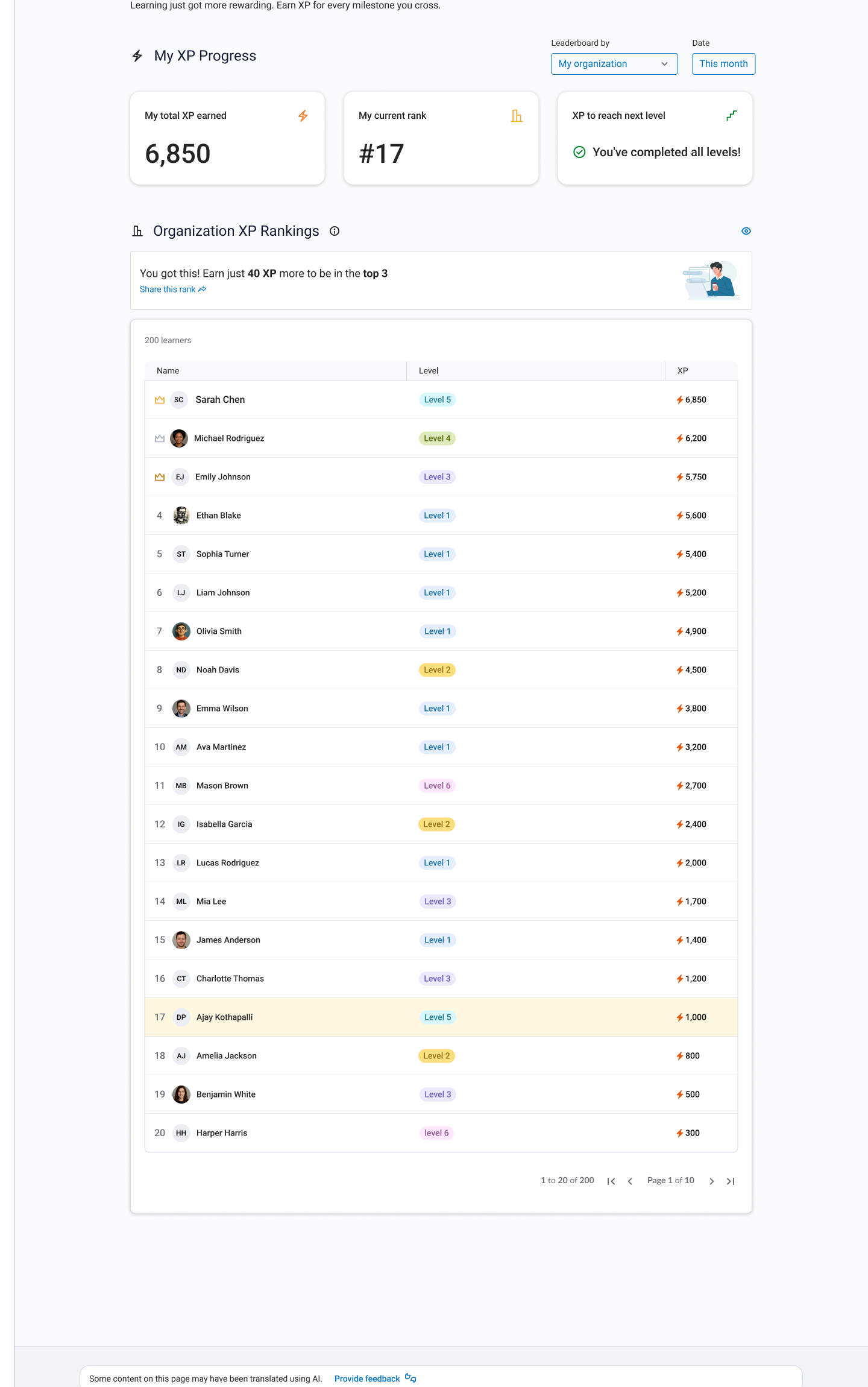
The leaderboard — your XP, rank and next level up top, a nudge when the top three is within reach, then the organisation's rankings with each person's level
10 — Where XP Lives
Where XP Lives
The nav pill is the primary surface — quiet, always current, one tap for your level and what is next. The tracker page exists for people who want detail, not as the front door. The player chip shows what a piece of content is worth before you start it, so the reward is a reason to begin rather than a surprise at the end.
The completion moment puts XP next to the badge and certificate, not instead of them. The tracker itemises every award with a date and the action that earned it — an economy you cannot audit is an economy you will not trust. The in-product FAQ answers eleven questions, because an economy nobody understands is a rumour.
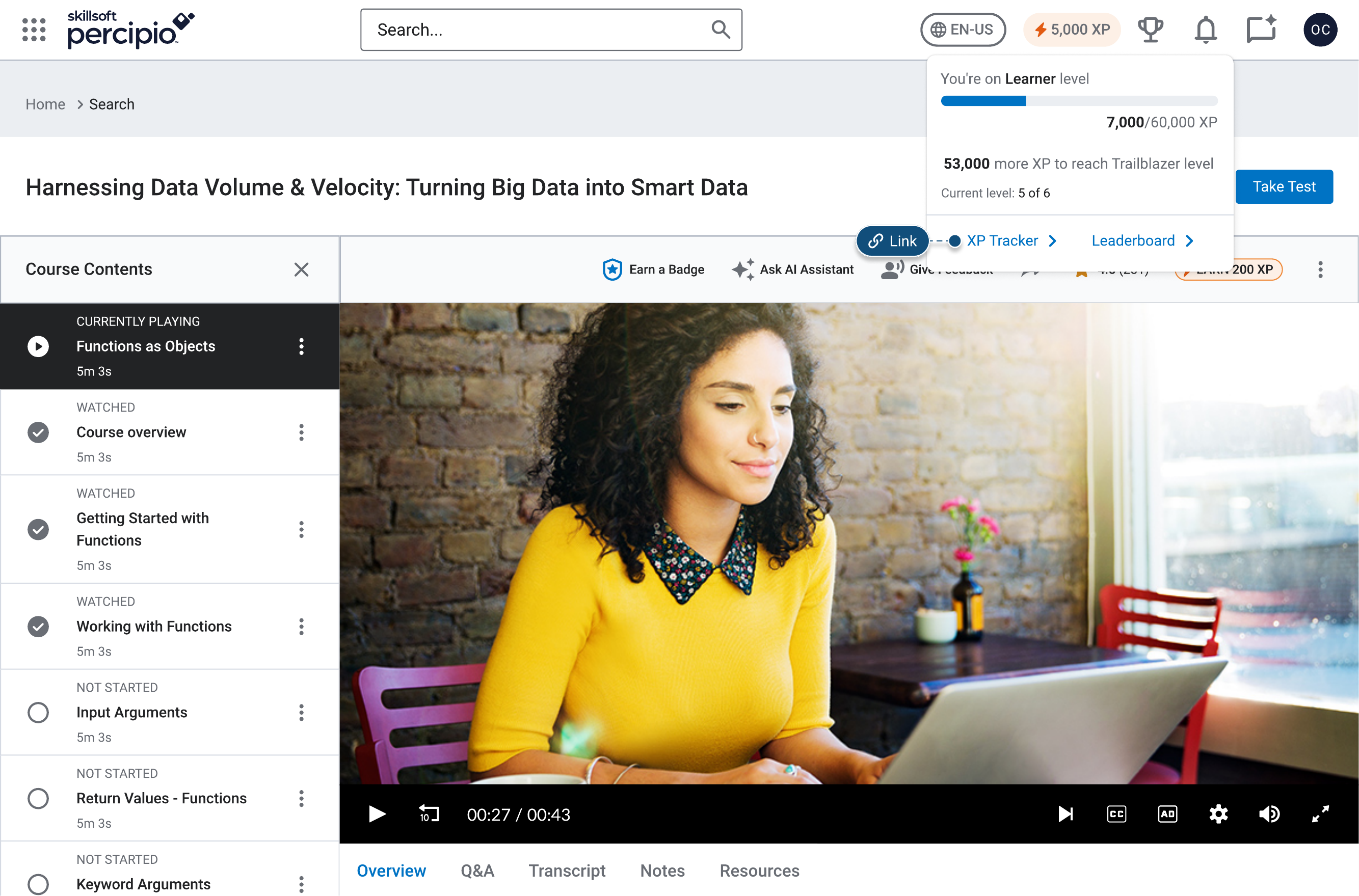
The nav pill and level panel — the primary surface, and the only one most people ever see
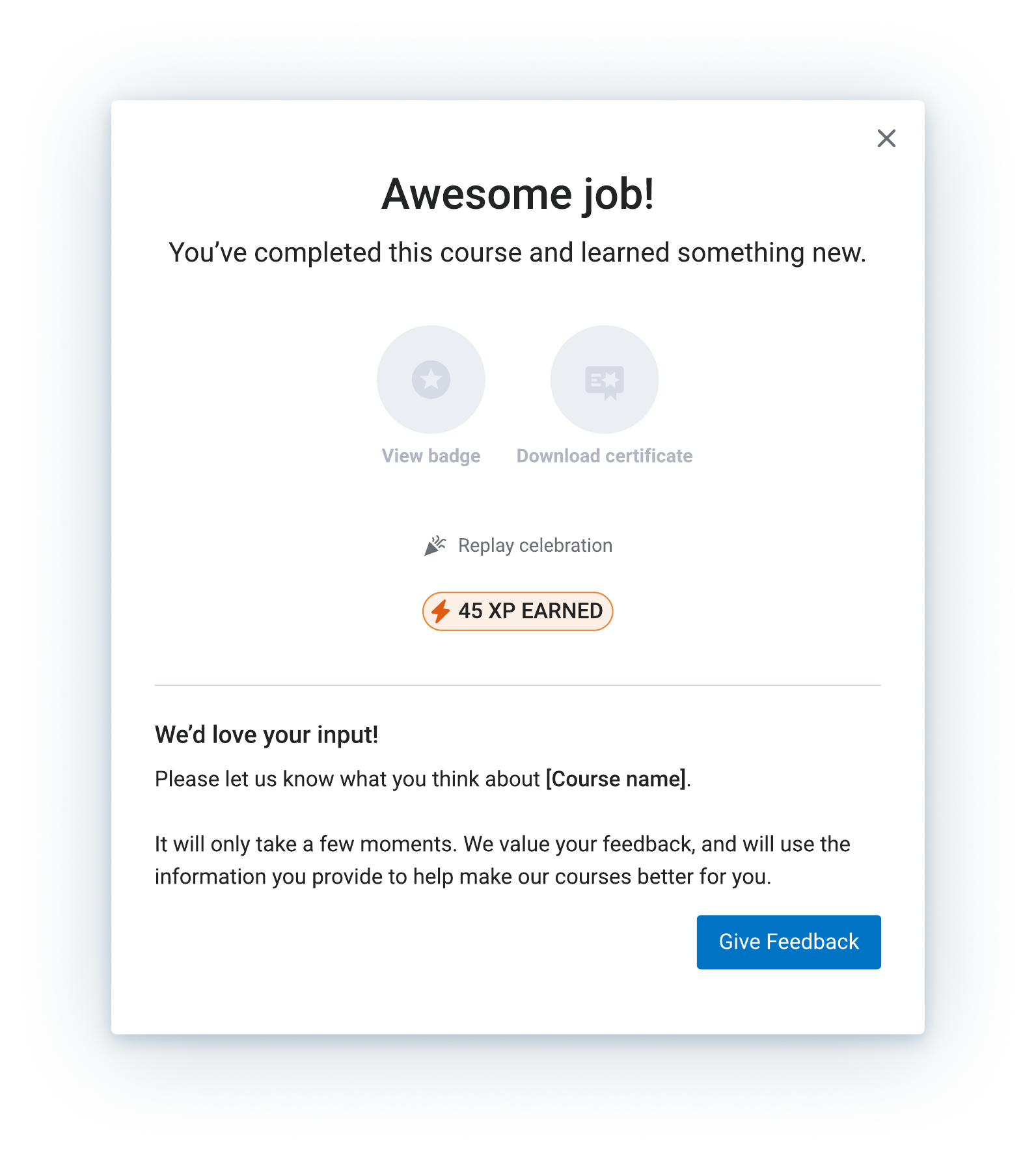
The completion moment — XP sits alongside the badge and certificate, never in front of them
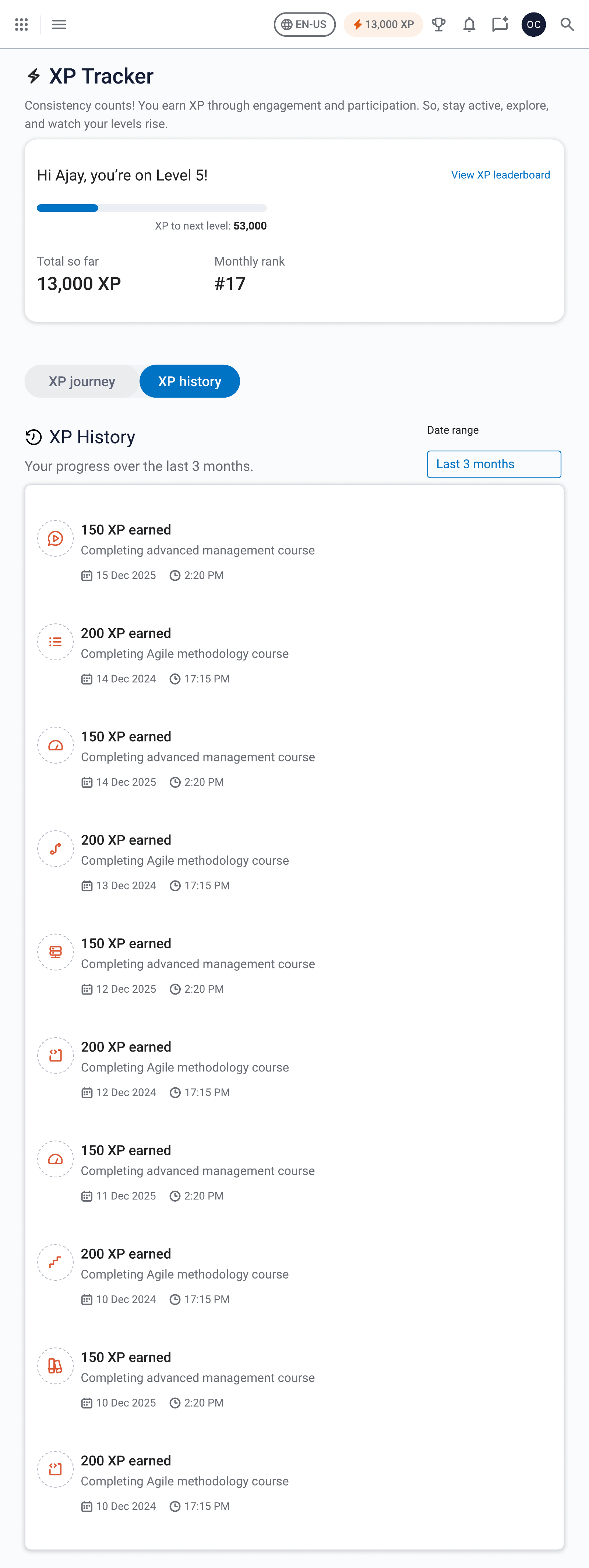
The tracker — every award itemised, dated, and attributed to the action that earned it

The in-product FAQ — eleven questions answered where the economy is used
11 — Recognition Without Humiliation
Recognition Without Humiliation
A leaderboard's default failure is making most people feel worse. Ranking is zero-sum and most users are, by definition, not near the top. So nobody is ever shown how far behind they are. Top rank maintains rather than gloats. Just off the board is the only message with a number in it, because it is the only place the number is reachable. Mid-pack gets encouragement and no comparison at all.

Top of the board — maintain, do not gloat

One place off — the only message that quotes a number, because it is the only one within reach
12 — States and Edge Cases
States and Edge Cases
The states are where a rewards system either earns trust or quietly loses it.
- Empty state points at the library rather than at itself — an empty rewards page is otherwise just an accusation
- Updating state exists because awards settle asynchronously — a stale number costs more trust than a spinner
- All-levels-complete still has to say something useful
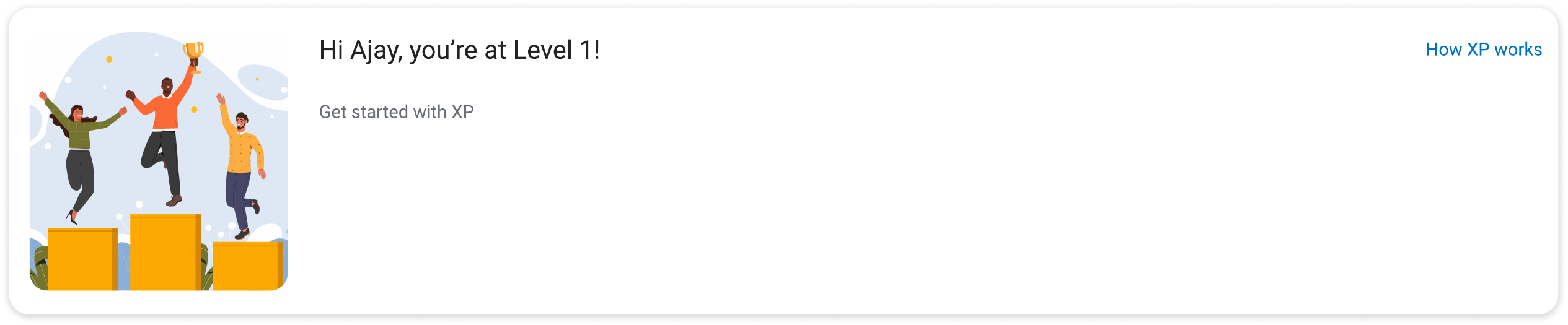
Level one — the zero state points outward, at the library
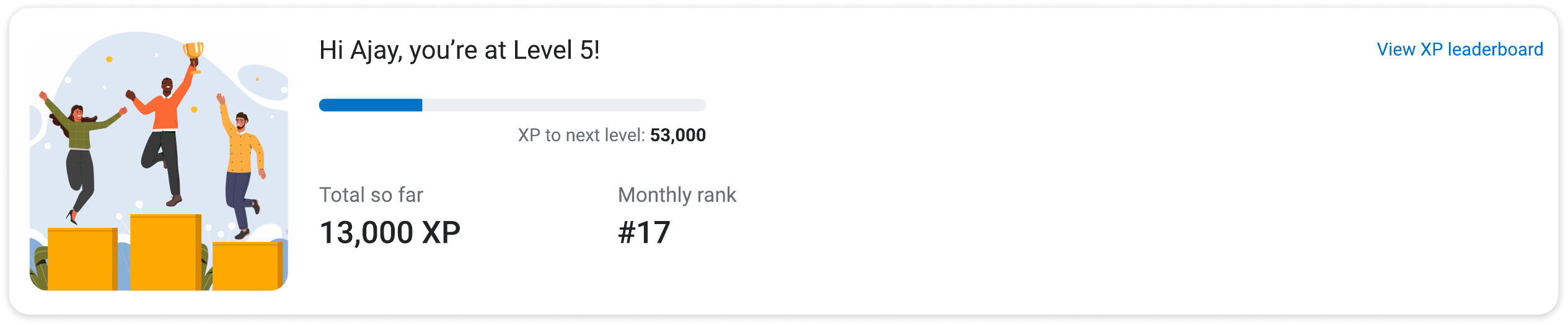
Mid-climb — progress and what is next
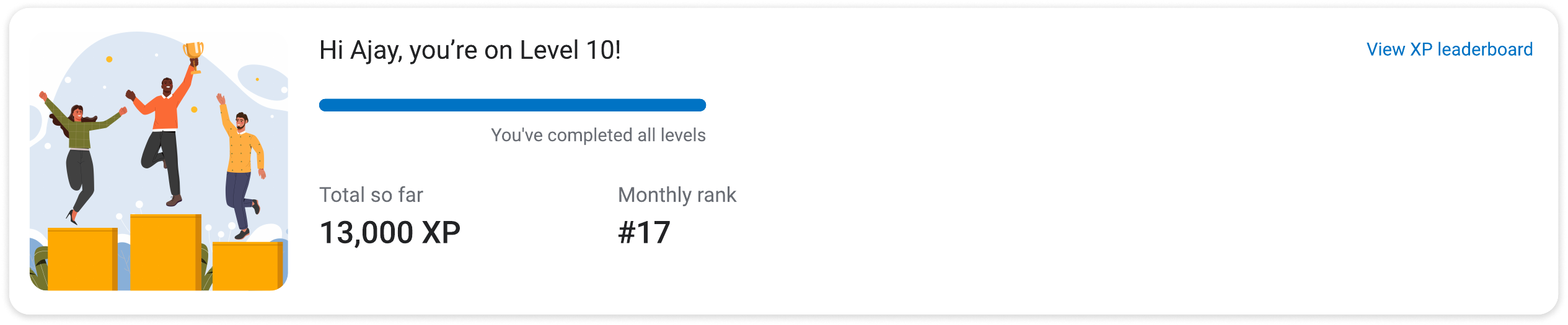
Every level complete — still has to say something
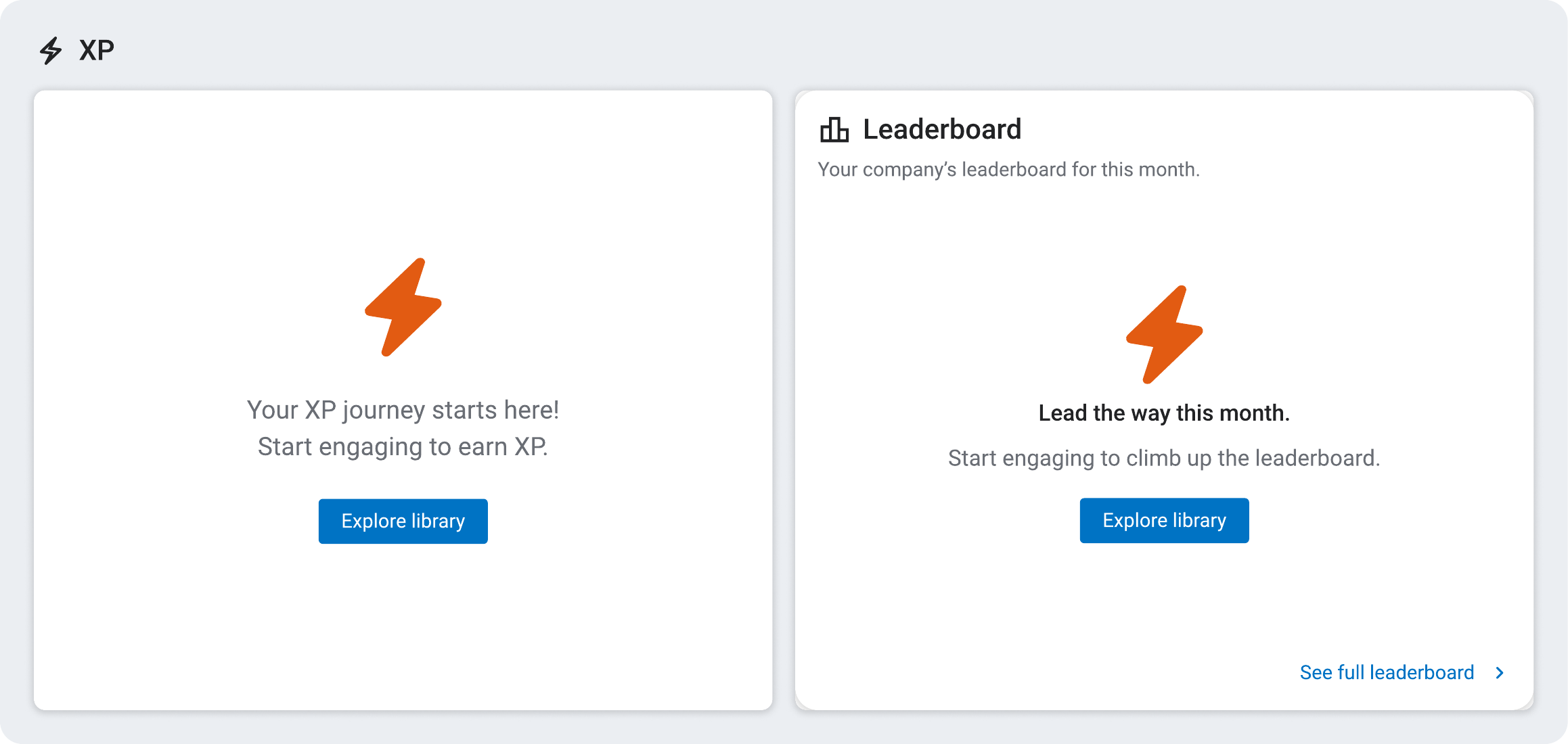
Empty states across the XP surfaces
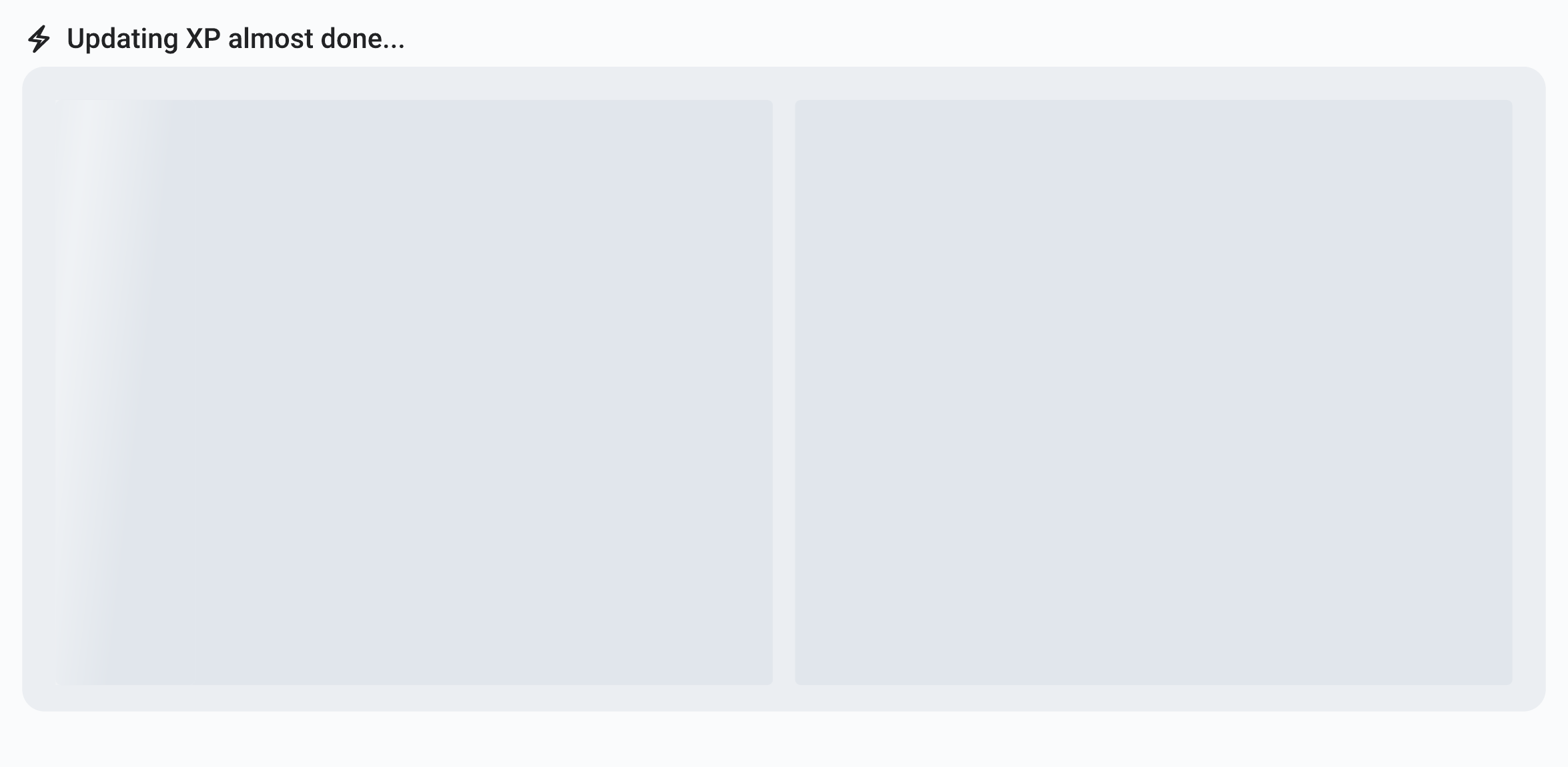
The updating state — awards settle asynchronously
13 — Accessibility
Accessibility
Treated as a design constraint, not a box ticked at the end. XP went through a formal accessibility review across every surface it touches — content pages, the celebration, the course-completion modal, the leaderboard, the global header, the XP landing page and XP inside My Learning — and the output was a markup specification for engineering, not a list of notes.
The hardest surface was the smallest one. The XP pill in the header opens a panel on hover, and a panel that only opens on hover does not exist for anyone using a keyboard. Rewriting it as a button with aria-expanded is the fix, but the review went further than the fix: the panel has to sit flush against the trigger, because if there is dead space between them the panel closes while you move the mouse toward it — a WCAG failure for content on hover. Where the DOM could not place the panel next to its button, the review specified the fallback exactly.
Seven decisions, not seven checkboxes
Each came from a real exclusion risk, not from a compliance list:
- Colour never carries meaning alone — XP uses an orange lightning glyph on a tinted chip. Colour, icon and text label all carry it, so it reads in greyscale and for any colour vision deficiency.
- Orange fails AA contrast against white at small sizes — restricted to glyphs and chip fills with dark text over them. Percipio is white-labelled, so the pill renders on whatever brand colour a customer has configured; the chip had to hold up on all of them, not just on ours.
- The header XP pill is a button with aria-expanded, not a hover surface. It opens on focus, Esc collapses it from either the button or the panel, and focus returns to the button on close.
- No dead space between the pill and its panel. If the pointer loses the trigger before the panel takes hover, the panel closes as you reach for it — that is a WCAG failure for content on hover, and it is invisible until someone tries.
- Where the panel cannot follow its button in the DOM, its container takes role=“region”, aria-label=“XP details” and tabindex=“-1”, and activating the button moves focus into it — so the panel is reachable in reading order even though the markup cannot put it there.
- Celebrations, counter increments and confetti all respect prefers-reduced-motion and jump to their end state. Replay is deliberate — on repeat, the animation is something you choose.
- Awards announce through a polite live region so nothing interrupts playback, as a sentence — “45 XP earned” — not a bare number. The leaderboard is fully keyboard-navigable, and opting out of it never costs XP.
Open the accessibility review in Figma ↗Every surface reviewed, with the markup specification handed to engineering.
A panel that only opens on hover does not exist for anyone using a keyboard. The review caught that before it shipped, which is the only time catching it is cheap.
14 — One Economy, Four Surfaces
One Economy, Four Surfaces
XP had to work on desktop web, mobile browser, native app, and inside an embedded course player. The points are the same everywhere. Almost nothing else could be.
The nav pill
The constraint that sets everything else. On desktop it sits in the global header with its value beside it and opens a panel on click. On mobile there is no room for a five-digit number next to a search field, a language selector and an avatar — so the pill degrades to the glyph alone and the value moves into the panel. What survives the collapse is the signal that XP exists, not the number. That is the right thing to protect: the number is detail, the presence is the habit. It clears 44px on touch, where there is no hover to make it discoverable.
The tracker
Inverts. On desktop it is a summary card above a two-column history. On mobile the history becomes a single scrolling column and the summary compresses — level, progress bar, XP to the next level, then recent awards.
The leaderboard
I designed the desktop board: rank, avatar, name, level and XP, crowns on the top three, and your own row highlighted wherever it falls. A mobile version shipped too, designed by another designer on the team.
The completion moment
The one thing that stays identical. Same modal, same XP chip, same hierarchy — badge and certificate first, XP alongside. It is the highest-emotion moment in the product and the one most likely to be someone's first encounter with XP. Consistency mattered more than optimisation.
And the embedded player, where the principle gets tested properly. The earn chip sits in a toolbar shared with badge, AI assistant, feedback and rating. On narrow viewports that toolbar overflows, and XP is not the most important thing in it — someone mid-course needs the transcript more than they need to know what they will earn. So the chip sits early in the overflow order rather than pinned. A reward system that pushes out a functional control has misunderstood its own priority.
15 — The Admin Layer
The Admin Layer
The real deliverable was not a points system. It was the set of levers an admin pulls when their business changes: XP value per action, which actions are eligible at all, the weekly ceiling, cooldowns per action, and a global on/off. Because some organisations will never want this — and that is a legitimate configuration, not a lost sale.
Design the system, not the screen. A platform that keeps growing needs rules for how it organises itself, not a fixed answer for today.
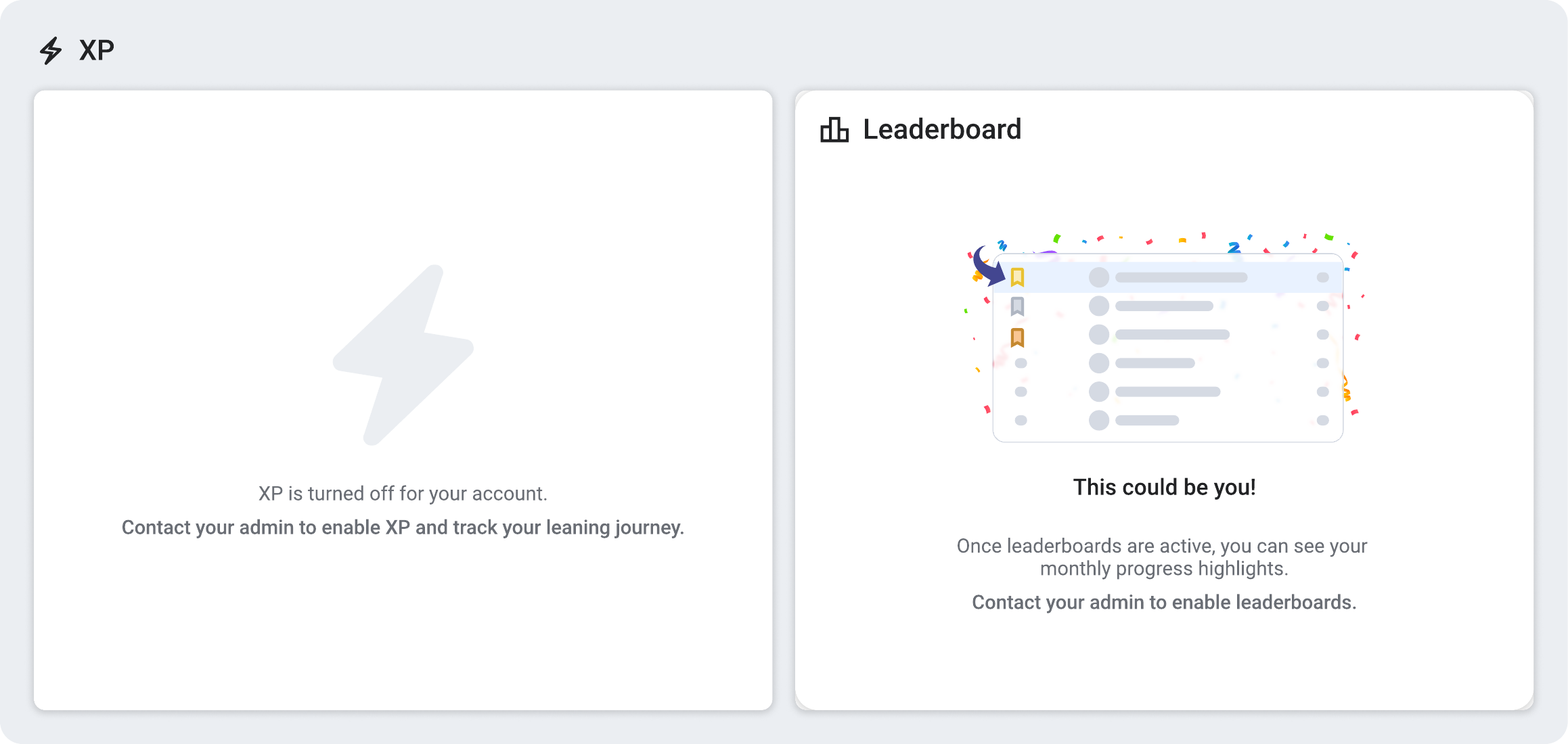
XP switched off for an organisation — a designed state, not a broken one
16 — Notifications
Notifications
A reward system throws off a lot of events. Nearly all of them are noise. For phase one I kept XP out of the in-app bell and sent it to email. The bell is for things needing action — assignments, deadlines, messages. Putting 'you earned 45 XP' in there would have devalued the whole channel to make a points system look busy.
Four types shipped: reaching a level, being close to the next one, leaderboard movement, and a year-end summary of what you learned. Milestone-completion notifications got cut — learners already get a completion confirmation. A second one for the same event is duplication dressed up as delight.
17 — What Review Caught
What Review Caught
Before any of this reached a user it went through design review — product, engineering, content strategy, other designers. I kept the notes. They are more useful than a tidy summary of them, because almost every one of them is a decision you can point at in the shipped product.
The number did not agree with itself
The nav pill said one figure, the hover card said another, the tooltip said a third. “In the progress bar I have gained 5,000 XP, but the tooltip says 10,000. Is it intentional?” It was not. An economy whose own surfaces disagree about your balance is not one anyone will trust — which is why the shipped tracker itemises every award with a date and the action that earned it.
The hover panel was doing too much
“Too much to process in a small window.” “Too much information on hover.” “On the first screen it doesn’t seem like an interactive element.” Overloaded and undiscoverable at the same time. The shipped nav pill is a button, not a hover surface. It reads as an accessibility decision. It is also just the thing review kept asking for.
Nobody could say what XP was for
“I would like to know what XP stands for and what advantage I get with progressing.” “I don’t know what to expect from my XP journey.” “Maybe a section where users can see what benefit they get at each level.” The in-product FAQ and the published earn rates are the answer to this cluster, and the reason both exist at all.
‘Journey’ already meant something else
Percipio ships an asset type called a journey. Using the same word for the level ladder was a collision caught in review rather than in production. Naming inside a mature product is constrained by the names already taken — a thing that does not show up in any gamification literature.
And one note I did not act on, which I should have taken more seriously: “Do we need levels at all? What if I keep collecting XP and then spend it — a gift card at 4,000 XP, another at 12,000?” I filed it as phase two. The thing that failed after launch was the ladder. Someone asked whether the ladder was the right container before I built it, and I had an answer ready instead of a question.
18 — Validation
Validation
Design review is not user testing. Before launch I took XP to ten people in a qualitative study. What they said is below — and so is the protocol each session was built around, because a study is only as good as what it was designed to catch.
Rollout was staged by organisation opt-in rather than a global switch. The release strategy and the product architecture were the same decision: any customer could decline it entirely, so 'off' had to be a first-class state.
8 of 10
Liked it and wanted it live
and expected it to turn learning into a habit, the way it had for them on apps like Duolingo
Some
Already chase rewards elsewhere
opening games just to collect a reward, then staying to play for the XP
How I read it
Saying you will build a habit is not building one — people predict their own behaviour badly, so 8 of 10 is intent, not proof. The second finding mattered more: rewards get people through the door, which is the case for XP living where people already are, and the reason the economy pays for the learning, not the visit.
“I go to some games just to collect the rewards, and then start playing them to collect the XP.”
Participant · qualitative study
“I would like to know what XP stands for and what advantage I get with progressing.”
Design review
“In the progress bar I have gained 5,000 XP, but the tooltip says 10,000. Is it intentional?”
Design review
“Do we need levels at all? What if I keep collecting XP and then spend it?”
Design review
What each session was built to catch
Every hypothesis had a way of being proven wrong before launch:
- Location — complete a course with no mention of XP in the brief. Did people notice the nav pill on their own? Could they find the tracker without help?
- Managers — show a manager their XP surface cold. Can they say what they would do next? Does recognition read as recognition, or as being monitored?
- Farming — the adversarial session: ask directly how you would run the score up without doing the real work. Every exploit named is a design defect found for free.
- One economy — show learners a board with managers on it. Does it read as unfair? Does role filtering fix it?
- The real test: 'What would you do tomorrow to earn more XP?' If someone cannot answer it, the economy is not legible, whatever the screens look like.
19 — What Shipped
What Shipped
Learner XP across every content type — courses, videos, audiobooks, books and summaries, skill benchmarks, CAISY scenarios and study groups, with journeys paying double. Profile XP with diminishing returns. A six-level progression — Learner, Explorer, Practitioner, Scholar, Trailblazer, Luminary — with published thresholds. One XP currency with separate leaderboards for learners and managers — after a first release with one combined board — filterable by organisation and date range. The XP tracker with itemised history. An in-product FAQ answering eleven questions. Manager XP for assignments, reports, and reminders that learners act on. The full admin configuration surface. Four email notification types. Every empty, off, updating and complete state.
Open the XP design in Figma ↗The shipped learner, manager and admin surfaces.
20 — What the Data Says
What the Data Says
The number XP was built to move: in organisations that turned XP on, monthly active learners rose 6.92% in the first month after launch, measured in Pendo. I had left Skillsoft by the time it was read; the Percipio team shared it afterwards. The rest reads a top-ten-per-organisation leaderboard export — 701 organisations, 5,360 users — which samples each organisation's highest earners, not everyone.
+6.92%
Monthly active learners, opted-in organisations
the first month after launch, measured in Pendo
2.6%
Codecademy's comparable result
skill XP on code submits — consumer learners who chose to be there
30–60%
What the business case projected
ranges put to leadership before launch
How to read it
Above the low single digits I told the team to expect, and far below what the business case projected. It is one month, so some of it is novelty — the months after are the real test. And it covers only organisations that chose XP, which may have been keener to begin with; with no holdout group, it says engagement rose where XP went live, not that XP alone caused it.
- One economy, settled by customers: On the first, combined board, customers reported that managers were earning more XP than learners — they had more ways to earn it — and asked for separate boards. That is the risk this bet named, showing up in practice, and the split I had proposed fixed it. In this export, learners hold the top spot in 87% of organisations and managers in 3.3%, with 2.6% of all leaderboard positions. The export is not dated against the split, so it cannot show the before and after.
- Managers responding to recognition did not hold: The managers who were active out-earned learners — that was the complaint. But most managers still barely showed up. Recognition on its own was not enough to activate a group that had never arrived in the first place.
- Location and farming are unproven: This export cannot speak to either one. It samples top earners, so it cannot tell me whether XP changed behaviour for the median learner, and it has no before-and-after on farming. Claiming either from this data would be the same mistake as quoting a vendor's own engagement statistic back at myself.
21 — What I Got Wrong
What I Got Wrong
I designed a ladder with a 54-week gap in it. Scholar, the fourth level, sits at 6,000 XP — about six weeks in. Trailblazer, the fifth, sits at 60,000. Between them there is nothing to reach for.
What went wrong
I curved the early levels for onboarding and let the later ones follow the three-year contract length. That optimised the first month and abandoned the third. 37% of these users sit below the first threshold. 15% sit in the band below the gap. 0.7% ever cross it — and these are each organisation's top ten. If your best people cannot reach the middle of the ladder, it is not a ladder. The nav dropdown tells someone on level 5 of 6 that they need 53,000 more XP. That is not a goal. It is a wall with a number on it.
How it was corrected
The fix is not more levels — more thresholds on the same curve just relabels the problem. It is sub-goals inside the long climb: monthly streaks, rank relative to your org, seasonal resets. Things that move while the level number stays still. That is the recommendation on the table, not something already shipped.
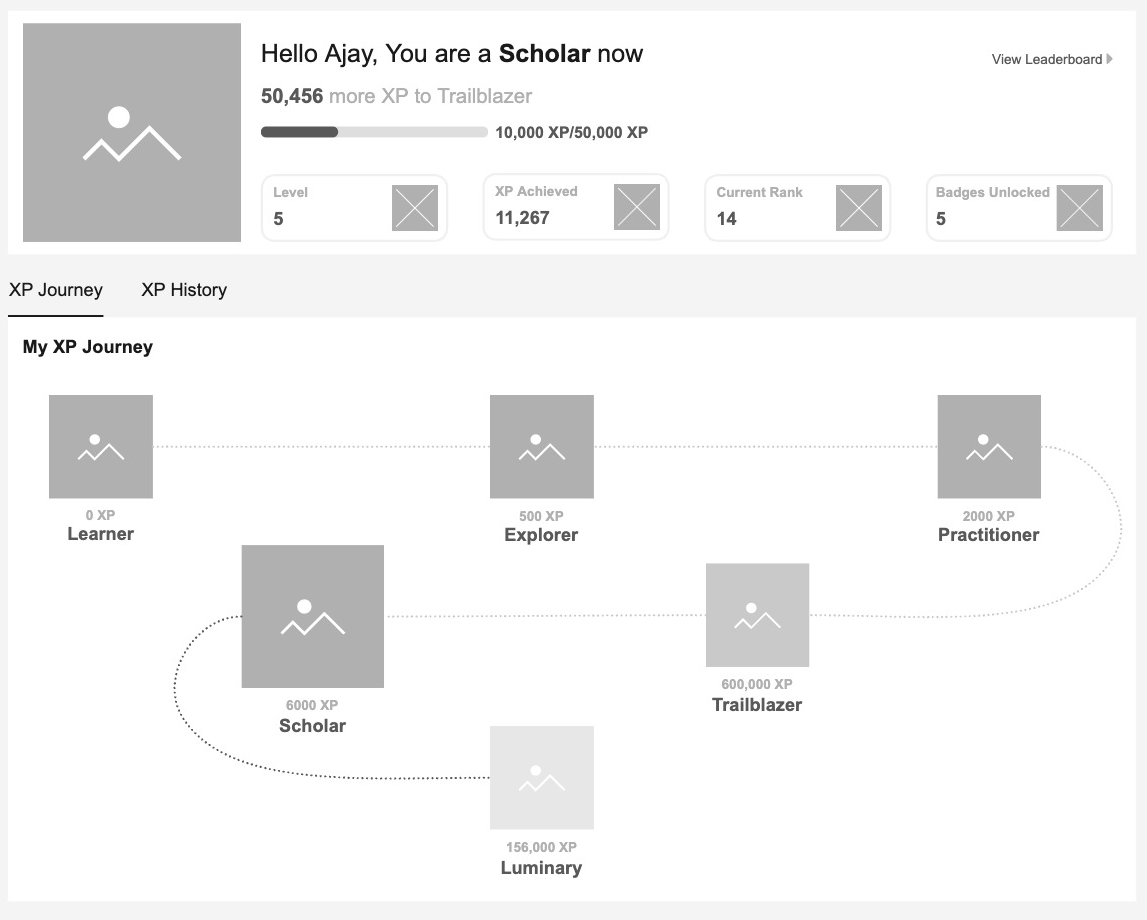
The gap was there in the first wireframe — Scholar at 6,000, Trailblazer two orders of magnitude past it. It shipped at 60,000 instead of 600,000, and was still a wall. I drew the shape and did not read it.
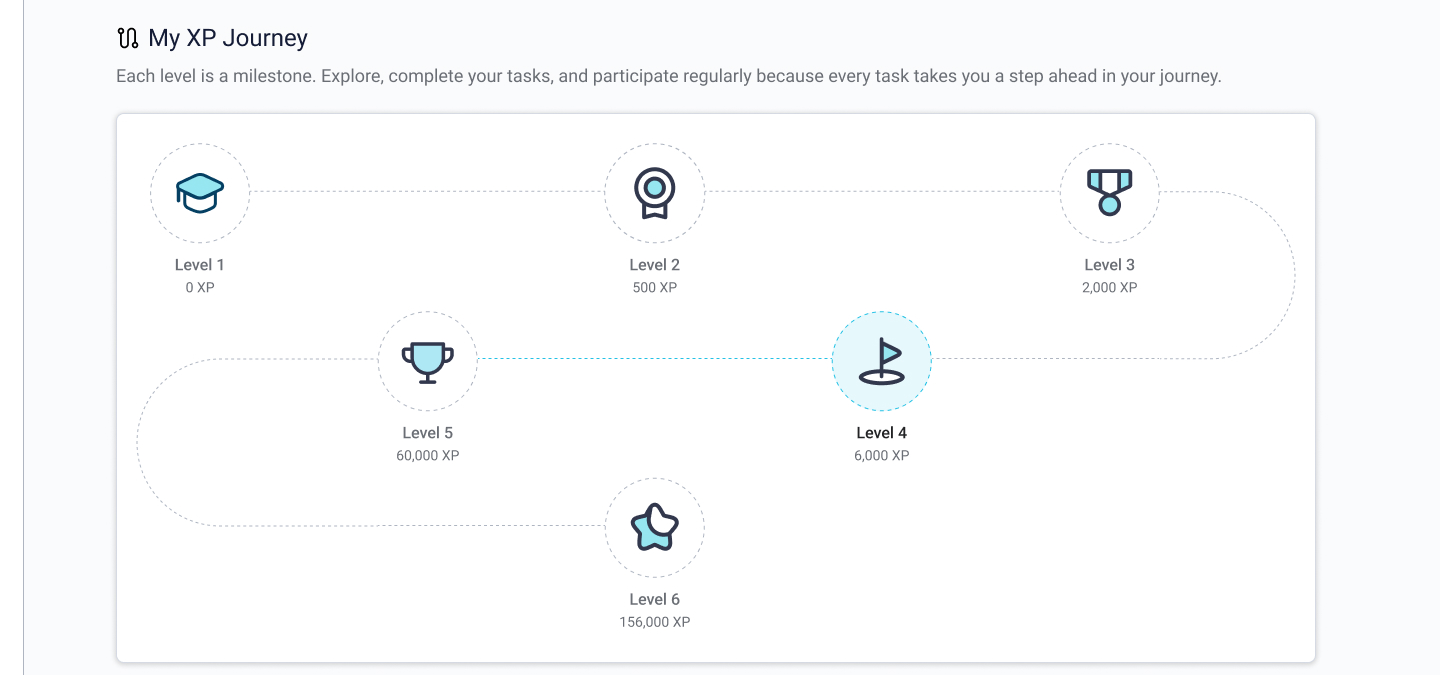
And it shipped that way — 2,000 XP to level 3, 6,000 to level 4, then 60,000 to level 5
22 — Next
Next
- Rebuild the middle of the ladder with sub-goals — monthly streaks, seasonal resets, rank movement as a near-term target while the level number stays still
- Read the 6.92% past its first month, when novelty wears off, and against a holdout group inside the opted-in organisations — so the next result says what XP caused, not only what happened after it.
- Solve manager activation properly — the recognition bet failing tells me the barrier is orientation, not motivation. Managers do not know what the platform lets them do, and points cannot teach them that.
- Phase two: redemption, which makes the economy real and introduces inflation — a harder problem than accrual
- Team leaderboards, deliberately held back, because collective ranking at work has real potential to go wrong
23 — Reflection
Reflection
In organisations that turned XP on, monthly active learners rose 6.92% in its first month — above the low single digits I told the team to expect, and well short of the 30–60% the business case promised. That gap is the honest result: points help, an economy helps more, and neither is a growth engine on its own. The managers XP was also meant to bring in mostly still haven't arrived — that is the next problem, not a footnote to this one.